


 Location:


China Media Group’s CCTV-9 Documentary Channel aired the major documentary The Long Development on August 27, 2026. Five years in the making, the production team traveled across four continents and nine countries to capture this epic narrative. The film is the first to showcase the millennia-long struggle between humans and pathogenic microorganisms comprehensively.
The fifth episode of the documentary, “The Boundless Net,” turns its lens on the “mosquito factory” operated by Guangzhou Wolbaki Biotech Co., Ltd. (hereinafter referred to as “Wolbaki”). The episode spotlights the company’s efforts to safeguard public health through its innovative "using mosquitoes to control mosquitoes" technology, while detailing its initiatives to bring this Chinese solution to the global stage.
The fifth episode of the documentary, “The Boundless Net,” turns its lens on the “mosquito factory” operated by Guangzhou Wolbaki Biotech Co., Ltd. (hereinafter referred to as “Wolbaki”). The episode spotlights the company’s efforts to safeguard public health through its innovative "using mosquitoes to control mosquitoes" technology, while detailing its initiatives to bring this Chinese solution to the global stage.
Figure 1: Professor Xi Zhiyong is observing the mosquitoes in the mosquito cage.
In the program footage, Gan Renxian, a researcher with Guangzhou’s “Fighting Mosquitoes with Mosquitoes” team, opens a transparent plastic container, and a swarm of mosquitoes pours out. These are not ordinary pests, but “beneficial mosquitoes” tasked with the mission of technology-based mosquito control—sterilized male mosquitoes carrying Wolbachia.
The principle behind the “using mosquitoes to control mosquitoes” technology lies in biological “sterilization.” Researchers use mosquito factories to mass-produce male mosquitoes carrying Wolbachia and release them into the wild. These male mosquitoes do not feed on blood or bite humans, and their sole purpose is to mate with wild female mosquitoes. Since female mosquitoes typically mate only once in their lifetime, once they mate with a sterile male, the eggs they lay will fail to hatch normally. This effectively breaks the reproductive cycle of mosquitoes such as the Aedes albopictus at its source, thereby achieving long-term mosquito control.
The principle behind the “using mosquitoes to control mosquitoes” technology lies in biological “sterilization.” Researchers use mosquito factories to mass-produce male mosquitoes carrying Wolbachia and release them into the wild. These male mosquitoes do not feed on blood or bite humans, and their sole purpose is to mate with wild female mosquitoes. Since female mosquitoes typically mate only once in their lifetime, once they mate with a sterile male, the eggs they lay will fail to hatch normally. This effectively breaks the reproductive cycle of mosquitoes such as the Aedes albopictus at its source, thereby achieving long-term mosquito control.
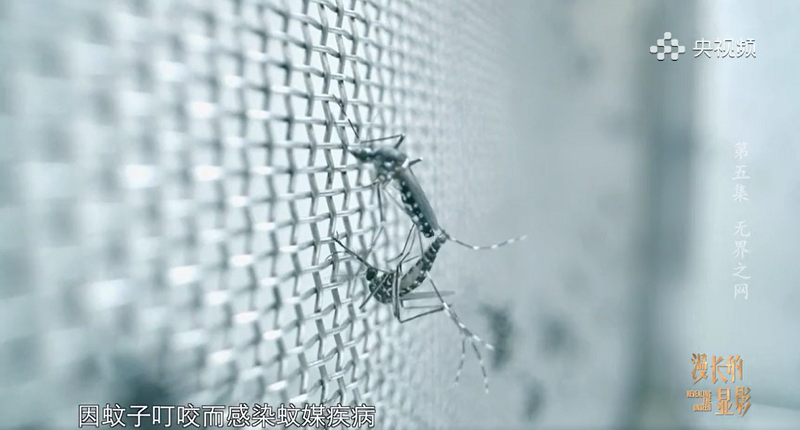
Figure 2: A male and a female mosquito preparing to mate
This technology has been certified by the World Health Organization as a safe, effective, and environmentally friendly method for mosquito-borne disease control. It has achieved significant results in Guangzhou, Foshan, Jiangmen, and other locations, effectively reducing the Aedes albopictus mosquito population by more than 90% and significantly lowering the risk of mosquito-borne diseases such as dengue fever.
Production Capacity and Practical Effectiveness: The Technological Defense Line from the Laboratory to the CommunityWolbaki currently has a robust production capacity of 5 million male mosquitoes per week. Since 2015, this technology has undergone release trials in multiple areas of Guangzhou, yielding significant results. To date, the “mosquito-based mosquito control” technology has been implemented in multiple communities across Guangdong.
Going Global: China's Blueprint for Factory Construction in Mexico
The Long Development also chronicles the global expansion of China's mosquito-control technology. In September 2018, Professor Xi Zhiyong, head of the “Mosquito Factory,” traveled to Mexico’s Yucatán Peninsula to attend the opening and ribbon-cutting ceremony for Mexico’s first “Mosquito Factory.” This marked the official launch of production at the first overseas “mosquito factory” backed by Xi Zhiyong’s team.
Following the launch, the Mexican partner team traveled to Guangzhou for comprehensive training on the large-scale production of Wolbachia-infected mosquitoes, field trials, and community education. Today, the Mexican “Mosquito Factory” has established a laboratory for the biological control of Aedes aegypti. By mass-producing sterile mosquitoes and combining Wolbachia with radiation technology, it combats mosquito-borne diseases such as Zika, dengue fever, and chikungunya. Currently, this technology has been applied in multiple countries, including China, Singapore, Mexico, and Brazil, demonstrating broad prospects for international application.
Figure 3: Mass-production facility for sterilized insects
Shifting from traditional chemical pesticides to innovative biological control, China has redefined mosquito management from manual eradication to “using mosquitoes to control mosquitoes.” The documentary The Long Development uses a “mosquito factory” as a window to showcase how a Chinese company is addressing global public health challenges through biotechnological innovation. Extending from Huangpu to the global stage, this cross-border “mosquito-free net” stands as a testament to how Chinese ingenuity is helping to build robust global public health defenses.
From the popular science explanations in the 2016 documentary Into Science, to the in-depth focus of the 2018 documentary Innovative China, to the ongoing coverage in the 2025 documentary Innovation in Progress, and finally to the international perspective of the 2026 documentary A Long Development, CCTV documentaries have used their cameras to document the complete journey of China’s “using mosquitoes to control mosquitoes” technology—from the laboratory to the world, and from technological innovation to a contribution to global public health.
Here is a link to a CCTV report on the mosquito factory:
(1) The Long Development* 20260823, Episode 5: The Boundless Net
http://tv.cctv.cn/2026/08/27/VIDEhUr0fcmc3fRKOfRkNQP8260827.shtmlHere is a link to a CCTV report on the mosquito factory:
(1) The Long Development* 20260823, Episode 5: The Boundless Net
(2) “Innovation in Progress” 20251009: The Battle Against Mosquitoes
http://tv.cctv.cn/2025/10/09/VIDEeMtRHdeZfvghgdkUXZS7251009.shtml
(3) *Innovative China*, January 25, 2018, Episode 4: Life
http://tv.cctv.com/2018/01/26/VIDE912MKY77JaToXDOxFlat180126.shtml
(4) “Approaching Science,” May 31, 2016: The Battle Against Mosquitoes
http://tv.cctv.com/2016/05/31/VIDEJtU5mEseZzf4KZ0ah2Fg160531.shtml


